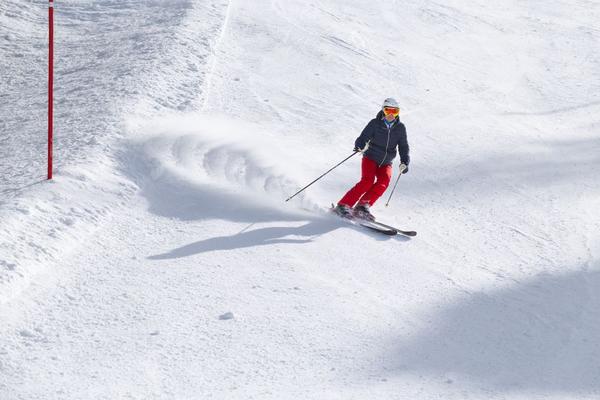
A clean carved turn feels different from an ordinary parallel turn. Instead of pushing the tails sideways to change direction, you tip your skis onto their edges and let their curved shape guide you through an arc. The result is a smooth, grippy turn with less snow spraying behind you.
What Makes a Turn Carved Rather Than Skidded?
In a carved turn, the ski tips and tails travel along nearly the same curved path. Two narrow, parallel tracks in groomed snow are a useful clue. In a skidded turn, the tails slide sideways, leaving wider, brushed tracks. Neither movement is inherently wrong: skidding is essential for slowing down and managing steep or crowded terrain.
Carving works because a modern ski has sidecut, meaning its waist is narrower than its tip and tail. Tip that ski on edge while it is moving, apply suitable pressure, and it bends into an arc. The amount of turn you get depends on the ski, edge angle, snow, and speed. Trying to force a tighter arc by twisting your feet usually creates a skid.
Choose a Slope That Makes Learning Easier
Find a wide, uncrowded, freshly groomed green or gentle blue run where you can link round turns without racing downhill. A completely flat slope may not provide enough momentum, while a steep run can make the speed uncomfortable. Avoid hard ice, deep chopped-up snow, and narrow trails during your first carving sessions.
Check your equipment before blaming your technique. Secure, correctly fitted boots help transmit ankle movements to your edges. Skis with a noticeable sidecut and edges in good condition make the response easier to feel. You do not need specialized race skis. For more on choosing equipment, see our guide to selecting skis for groomed runs.
How to Carve on Skis, One Turn at a Time
Start in a Balanced, Athletic Stance
Keep your skis parallel and approximately hip-width apart. Flex your ankles, knees, and hips, with light contact between your shins and the front of your boots. Your hands should be comfortably forward, and your weight should feel supported through your whole feet, not just your toes or heels.
Look along the path you want to travel. Avoid throwing your shoulders toward the new turn; your legs should make most of the edging movements while your upper body stays relatively quiet.
Release the Old Edges and Tip Both Skis
As you finish one arc, gradually soften the edge angles until both skis pass through a flatter position. Then roll your feet and ankles toward the new edges, allowing your knees and legs to follow. To turn left, for example, the right ski becomes the outside ski and engages its left, big-toe-side edge.
Begin with a modest amount of tipping. Good edge control skiing is about progressive movements, not suddenly dropping your hips toward the snow. Let the skis start changing direction before adding more edge angle.
Balance Against the Outside Ski
Through the middle of the turn, gradually direct more pressure to the outside ski. Keep the inside ski lightly engaged and tracking beside it. As forces build, the outside leg generally feels longer while the inside leg flexes more, allowing your skis to tip without your whole body collapsing inward.
Keep your torso balanced over your support instead of simply leaning into the turn. Some inward movement is natural, but bending appropriately at the hips and keeping your outside ski underneath you helps its edge hold. The aim is grip and a smooth arc, not maximum knee angle.
Finish the Arc and Change Edges Smoothly
Allow the skis to travel farther across the slope as the turn ends. This rounder shape helps manage speed, although pure carved turns can still accelerate quickly. Reduce pressure and edge angle gradually, then move into the next turn without an abrupt jump or tail push.
Think of the rhythm as release, tip, build pressure, and release again. When each phase blends into the next, carved turns start feeling connected rather than forced.
Two Ski Turn Drills That Build Real Edge Control
Railroad Tracks on Gentle Terrain
On a mellow groomer, glide with parallel skis and lightly tip both onto one set of edges. Let them describe a shallow curve, flatten them, and tip to the opposite edges. Do not actively steer the tails. Stop and look uphill from a safe place: two thin curved lines suggest your edges are doing the work.
Match the Tracks, Not the Speed
Make four or five medium-radius turns on a groomed slope, concentrating on parallel skis and a patient edge change. Look back at the tracks after stopping safely off to the side. If one line is clean and the other is smeared, check whether you are rotating the inside ski or neglecting its edge angle.
If parallel turns still feel inconsistent, revisit our guide to parallel skiing basics before increasing the intensity of these drills.
Why Your Skis Keep Skidding
One common mistake is steering with the shoulders or twisting the feet at the start of every turn. That sends the tails across the snow instead of letting the sidecut work. Slow the movement down and try a shallower arc.
Another is leaning backward. When your hips drop behind your feet, the ski tips become harder to engage and edge changes feel delayed. Maintain gentle shin contact and let your ankles flex rather than reaching forward with your chest alone.
Finally, watch for abrupt edging, excessive inside-ski pressure, or terrain that is too steep for your current comfort level. Practice with smaller edge angles first. Carving is not the right tool for every moment; controlled skidded turns and reliable stopping remain important skills. Review ski stopping and speed-control techniques before practicing on busier runs.
Frequently Asked Questions
Can a beginner learn to carve on skis?
Yes, but it is easier after you can link balanced parallel turns and stop reliably. Begin with shallow railroad tracks on gentle groomed snow rather than steep terrain or high speeds.
Do you need special skis for carving?
No. Most modern recreational skis have sidecut and can make carved turns. A suitable length, secure boots, and maintained edges usually matter more to learning than buying race-focused gear.
How do I know whether I am actually carving?
Look for two relatively thin, continuous tracks where the tails follow the tips. You should feel the skis pulling smoothly into an arc with little sideways scraping or heavy snow spray.
Is carving always better than skidding?
No. Carving is efficient on appropriate open groomers, but it can build speed. Skidding gives you another way to control direction and speed, especially on steep, narrow, icy, or crowded sections.
Build Cleaner Turns Before Sharper Ones
The fastest way to improve ski carving technique is to make the first movements smaller and more accurate. Pick forgiving terrain, release your old edges, tip both skis together, and let pressure develop naturally against the outside ski. When your tracks become consistent, gradually vary your turn size and rhythm. Cleaner arcs come from balance and timing, not from forcing your skis harder into the snow.