
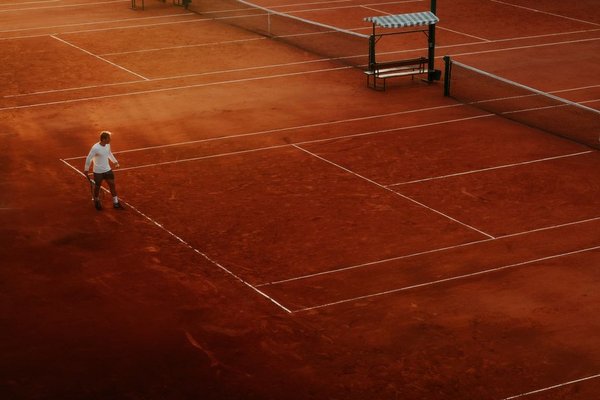
Good singles movement is not just about reaching the ball. Every shot changes the angles available to your opponent, so your next position should change with it. That is the practical idea behind singles tennis court positioning: recover to the centre of your opponent’s likely replies, not automatically to the centre mark.
For newer players, “return to the middle” is a useful starting cue. The singles court is 27 feet wide, so a central position gives reasonable access to both sidelines. As rallies become faster, shot direction, depth, and your distance from the baseline all matter.
The Centre Mark Is a Reference, Not a Destination
Think of tennis geometry as a moving triangle. Your opponent is one point, while the widest realistic replies form the other sides. Your job is to position yourself near the middle of those likely angles. That spot may be close to the centre mark or a step or two away.
After a crosscourt ball, a player may recover toward the middle and stop short of the centre. After a down-the-line change, the same player may move farther across it. Good singles court coverage changes with the shot.
How Shot Direction Changes Your Recovery
After a Deep Crosscourt Groundstroke
Crosscourt is the basic rally pattern for a reason. The ball passes over the lower part of the net, has more diagonal court available, and usually gives you more recovery time. If you are pulled wide and send a solid crosscourt ball back, move toward the middle but do not assume you must reach the exact centre mark before your opponent hits.
In many crosscourt exchanges, the geometric centre of the opponent’s replies remains slightly off-centre. Stopping about a step short of the middle can leave you better placed for another sharp crosscourt ball while still covering a change down the line. Recover closer to the true centre if your shot fails to push the opponent wide.
After a Down-the-Line Shot
A down-the-line change creates a different picture. You have redirected the ball to the opposite side, and the opponent may now have a large crosscourt target. Baseline positioning therefore usually needs to shift farther across the centre than it would after a routine crosscourt ball.
If you are stretched wide, hit down the line, and stay near that sideline, the opponent can use the open crosscourt space. Change direction when you are balanced enough to recover or when the shot itself puts the opponent under pressure.
After a Ball Through the Middle
A deep ball through the middle reduces the opponent’s available angles. Your recovery can be more central because the next shot is less likely to pull you immediately outside a singles sideline. It is a useful pattern when you need to reset a point.
Your Position Relative to the Baseline
Recovery is not only side to side. If your shot is short and gives the opponent time to attack, a safer base may be behind the baseline, where you have more reaction time. If you hit a deep ball that forces a weak reply, move closer to the baseline or step inside it.
Defend deeper under pressure, hold the baseline in neutral rallies, and move forward when your shot has earned that opportunity. The quality of the opponent’s position matters more than how hard you struck the ball.
Wide Balls: Buy Time Before You Recover
When an opponent pulls you outside the singles sideline, a high, deep crosscourt reply can be more useful than forcing a low-percentage winner because it gives you time to decelerate and regain court coverage. Use a crossover step when you need distance, then shorten your steps as you approach your base.
Aim to split-step as the opponent makes contact. Arriving balanced is more valuable than reaching an ideal spot late and still moving.
Approaching the Net Changes the Geometry
A well-placed down-the-line approach often simplifies recovery because you can continue forward on the same side and close the line while remaining ready for the crosscourt pass. A crosscourt approach can work, but it usually requires more lateral movement.
At net, the centre line is not automatically the correct destination. Move with the direction of your approach and split-step before the passing shot. Get close enough to reduce the target without crowding the net so much that a lob becomes difficult to cover.
A Practical Rally Example
Imagine you are pulled several feet wide on your forehand side. You choose a deep crosscourt forehand instead of forcing a winner down the line. As soon as you finish the stroke, you recover toward the middle, stop roughly a step short of the centre mark, and split-step as your opponent starts the forward swing.
Your opponent then leaves a shorter ball near the middle. You step inside the baseline and drive it down the line. This time your recovery changes: continue forward if the shot is strong enough to approach, or move farther across the centre if you stay back. Different shot geometry creates a different recovery route.
Three Recovery Mistakes to Avoid
Running to the Centre After Every Shot
The centre mark is useful, but automatic recovery can make you run farther than necessary and expose the sharpest angle. Let the direction and quality of your shot determine how far you move.
Watching Your Own Shot for Too Long
Once the ball leaves your strings, begin recovering. Even a brief pause can turn comfortable movement into a rushed scramble.
Running Through the Opponent’s Contact
Your recovery should finish with a split-step timed to the opponent’s strike. If you are still sprinting as they make contact, your first move to the next ball will be slower.
Frequently Asked Questions
Where should I recover after a crosscourt shot in singles?
Move toward the middle, but you may not need the exact centre mark. After a strong crosscourt ball, the best recovery point is often slightly off-centre because the available angles have shifted.
Should I always return to the centre of the baseline?
No. The centre is a useful starting reference, but effective singles court coverage depends on shot direction, opponent position, and the likely next angles.
How far behind the baseline should I recover?
There is no fixed distance. Recover deeper when the opponent can attack or when you need more reaction time. Move closer when your shot has pushed the opponent back or produced a weaker reply.
What is a good drill for recovery positioning?
Rally with a partner using crosscourt, down-the-line, and middle targets. After every shot, recover to the area that covers the likely reply and split-step at your partner’s contact.
Make Recovery Part of the Shot
Your target and your next position are part of the same decision. Hit crosscourt and understand the angles you created. Change down the line and expect your recovery route to change. Move inside the baseline only when the quality of your shot supports it.
Once you read rallies this way, recovery becomes less about chasing the centre mark and more about controlling space. Better singles tennis court positioning will make your movement earlier, more balanced, and better connected to the shot you just played.