
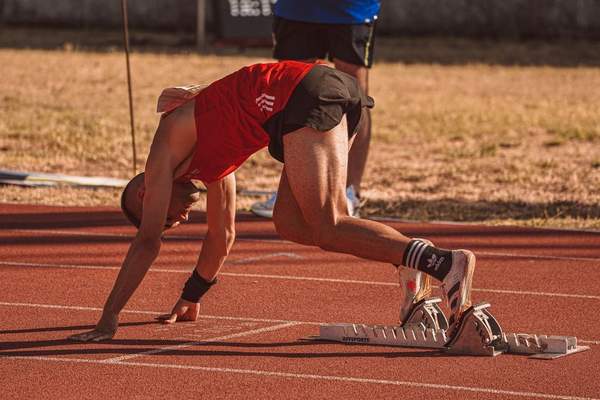
A fast sprint start is not simply about reacting first or exploding as hard as possible. The goal is to leave the blocks in a position that lets you apply force backward into the track, build velocity with each step, and rise gradually into efficient sprinting. Good sprint start technique connects block setup, the drive phase, and acceleration mechanics.
The first few steps can shape the whole race. Rush the rise and you lose useful horizontal force. Stay artificially low and you may shorten your stride or waste energy. The best start feels aggressive without looking forced.
Build a Repeatable Starting-Block Setup
Starting blocks should put you in a position where both legs can contribute immediately. There is no single spacing that fits every athlete because leg length, strength, mobility, and preferred front leg differ. Use a comfortable setup as a starting point, then adjust it based on consistency, timing, and video rather than copying another sprinter.
Place each foot firmly against its pedal. In the “on your marks” position, keep your hands just behind the line, roughly shoulder-width apart. In “set,” raise the hips and load the body forward while maintaining pressure through both blocks. If the hips are too low, the first movement can become excessively upward; if they are too high, stability may suffer.
Choose the Front Leg by Performance
Many athletes prefer one leg forward, but preference is not always performance. Test both arrangements over several starts and compare balance, first-step quality, and a timed 10-metre split. The better setup is the one that produces a clean, repeatable exit and stronger early acceleration.
Reaction Time Is Only the Beginning
Reaction time matters, but guessing the gun is not a reliable shortcut. A tense athlete can react quickly yet produce a poor first step. Settle into position, focus on the start signal, and make the first action a forceful push through the blocks.
The hands leave the ground as the legs drive. Think about sending the body forward rather than popping upright. Keep the head naturally aligned with the torso instead of forcing the chin down or immediately looking toward the finish. The start works best as one coordinated whole-body action.
Make the First Steps Powerful, Not Busy
The first steps of the sprint drive phase are about projection and force. Early ground contacts do not need to resemble the very short contacts seen at maximum velocity. You are overcoming inertia, so you need enough contact time to push effectively and gain speed.
A useful cue is “push the track away.” It encourages forceful extension without telling you to reach forward with the foot. Overstriding early can place the foot too far ahead and create braking. Let stride length grow naturally as velocity increases.
Rise Gradually Through Acceleration
A common mistake is treating the drive phase as a fixed pose. You do not need to “stay low” for an exact number of steps. World Athletics describes the early drive as a forward-leaning phase that transitions into a more upright sprinting position. The important part is that the transition happens smoothly as speed increases.
Think of acceleration mechanics as a sequence. The first steps project strongly forward. Each following step gains more vertical contribution as stride length and velocity increase. Your torso rises because the forces and step pattern are changing, not because you suddenly decide to stand tall.
This is why copying a fixed 10-metre or 20-metre body angle can be misleading. Stronger and more experienced sprinters may accelerate differently from developing athletes. Aim for progressive acceleration rather than trying to match a photograph.
A Practical 10-Metre Start Session
After a thorough sprint warm-up, perform four to six block starts over 10 metres with full recovery between efforts. Film from the side if possible. On each repetition, use only one cue: pressure through both blocks, push forward, or rise gradually.
Suppose your first two starts feel explosive but video shows your torso becoming upright by step two. On the next repetition, do not simply crouch lower. Focus on projecting the first step farther down the track while continuing to push behind you. If the adjustment improves the 10-metre time without causing reaching or stumbling, it is probably moving your technique in the right direction.
Keep quality high. Once starts become slow or sloppy, extra repetitions tend to reinforce poor habits. Block-start practice is most useful when you are fresh enough to produce near-maximal intent.
Common Sprint Start Errors to Fix
Popping Up Immediately
If the head and chest shoot upward, check whether the blocks are too close, the hips are too low, or your cue is encouraging you to stand instead of project. Use video to confirm what is actually happening.
Reaching With the First Step
Trying to manufacture a long first stride can create braking. Early acceleration comes from forceful pushing, not from placing the foot far in front. Let the stride lengthen as speed builds.
Forcing a Low Position
Staying low by bending at the waist is not the same as accelerating with a forward body angle. Keep the trunk connected and allow the whole body to rise progressively.
Training Starts While Fatigued
Repeated starts after hard conditioning can reduce power and alter mechanics. Place technical block work early in a speed session, when reaction, coordination, and force production are sharp.
Connect the Start to the Rest of the Sprint
A better start should feed the next phase rather than exist as a separate skill. Useful internal-link topics include sprint acceleration drills, maximum-velocity mechanics, a sprint warm-up routine, and 100m race strategy.
Frequently Asked Questions
How far should I stay in the drive phase?
Do not force a fixed distance. The forward body angle is greatest in the earliest steps and becomes more upright as you accelerate. Focus on a smooth rise that matches increasing speed.
Should my strongest leg be in the front block?
Often it is, but the best answer is individual. Test both setups and compare comfort, consistency, first-step quality, and timed acceleration. The faster, more repeatable arrangement is more useful than a rule of thumb.
How can I improve reaction without false starting?
Practise responding to varied start signals rather than anticipating a predictable rhythm. Stay composed in the set position and react to the signal with a complete push, not just a quick hand lift.
How often should I practise block starts?
Quality matters more than volume. Short sets of fully recovered starts can be included regularly in sprint training, but frequency should fit your overall speed work, strength training, competition schedule, and recovery.
Turn the First Steps Into Real Speed
The strongest sprint start technique is repeatable and connected. Set the blocks so both legs can contribute, react without guessing, push powerfully through the first steps, and let posture rise as speed builds. Use timed runs and video to judge whether a technical change improves acceleration. When block setup, drive phase, and acceleration mechanics work as one sequence, the opening steps become a launch into the race rather than a separate skill you have to recover from.