
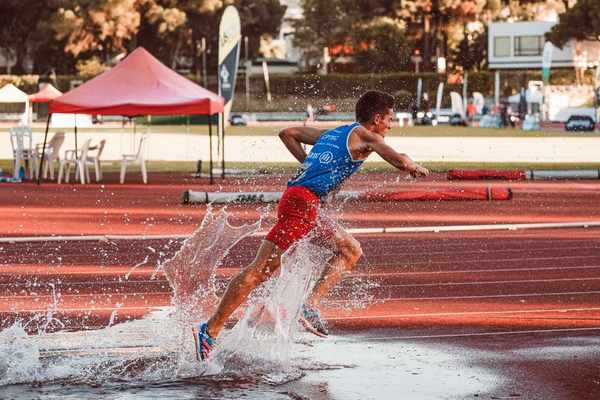
The 3000m steeplechase looks like a distance race until the field reaches its first barrier. Suddenly, runners must judge take-off points, protect their rhythm and prepare for a water pit while maintaining a fast pace. Those obstacles make the event one of the most technical races on the Olympic athletics programme.
Under the 3000m steeplechase rules, every competitor covers 3,000 metres and negotiates 35 obstacles: 28 fixed barriers and seven water jumps. Understanding how those obstacles are arranged makes the race much easier to follow, especially when a small mistake can change the leading positions.
How the 3000m steeplechase format works
The event is held on an outdoor athletics track, usually based on a standard 400m circuit. Runners cover roughly seven and a half laps, although the exact starting position and circuit layout depend on whether the water pit sits inside or outside the main track.
A mass standing start is used, without starting blocks. Athletes can move towards the inside once racing begins, rather than remaining in separate lanes. The opening section is free of obstacles; the barriers are encountered during the subsequent seven complete obstacle-bearing laps.
Each complete steeplechase lap contains five jumps: four ordinary barriers and one water jump. The water jump is the fourth obstacle in that sequence. The spacing is designed to be reasonably even, but the bend leading to the water pit changes the runner’s path.
How many steeplechase barriers are there?
There are 28 ordinary steeplechase barriers and seven additional barriers positioned at the water jumps. That produces 35 required clearances during the race. The distinction matters: the water-jump barrier counts as part of a water obstacle, not as an extra ordinary barrier.
Unlike the lightweight hurdles used in sprint and 400m hurdles races, steeplechase barriers are heavy and fixed. They are not designed to topple when struck. Runners may clear them in a hurdling motion or place a foot on the top before stepping off.
Barrier heights for men and women
At senior level, men’s barriers are 91.4cm high, while women’s barriers are 76.2cm high. Ordinary barriers are at least 3.94m wide. The barrier at the water jump is approximately 3.66m wide and is secured to the pit structure.
These dimensions create different technical demands from a flat 3000m race. A runner who loses momentum at every clearance must repeatedly accelerate to regain speed, even if their endurance is excellent.
Water jump rules and pit design
The water jump begins with a solid barrier, followed immediately by a pit measuring approximately 3.66m long and 3.66m wide. The pit is deepest beside the barrier, at about 50cm under current specifications, then slopes upwards towards track level.
Athletes must cross the water-jump barrier and go over or through the water area. They cannot run around the pit to avoid the obstacle. There is no requirement to land in the water itself: a sufficiently long leap can carry a runner towards the shallow end or beyond it.
Many athletes step on the water barrier and drive forwards from it. Others clear it without planting a foot. Both approaches can be legal. The objective is to land safely, preserve speed and avoid wasting energy splashing through deep water.
Why the water jump changes race tactics
Imagine two runners reaching the pit together. One lands near its deepest section and takes several awkward steps to recover. The other pushes off the barrier and lands nearer the shallow exit. Even if they approached at the same speed, the second runner may emerge with a valuable advantage.
That is why coaches study the last few strides before the barrier, not simply the leap. A controlled approach often saves more time than an ambitious jump made from the wrong position.
What counts as a legal barrier clearance?
Steeplechase competitors are allowed to touch or step on a barrier. They do not have to imitate sprint hurdlers by sailing cleanly over it. However, they must negotiate every required obstacle and cannot pass around its end.
They also cannot clear a barrier with a foot or leg passing beside it below the horizontal level of its top. At the water jump, bypassing the pit is prohibited. Missing an obstacle or failing to correct the route can lead to disqualification.
The rules do not reward a particular jumping style. A runner’s best choice depends on their speed, fatigue and surrounding traffic. Efficient clearances are usually smooth enough that the athlete resumes normal running almost immediately.
How runners manage the laps and the crowd
The first obstacle-free section gives the field time to establish position. Once the jumps begin, traffic matters. A runner tucked closely behind another athlete may have a restricted view of the barrier and little room to adjust their final stride.
Experienced competitors avoid unnecessary jostling and choose a line that leaves enough space to approach obstacles safely. The shortest route is not always the fastest if it forces braking before a jump. This is especially noticeable at the water pit, where athletes converge towards a narrower landing area.
During the middle 3000m steeplechase laps, consistency becomes more important than spectacular leaps. Towards the finish, athletes must decide whether to attack before an obstacle or wait until their running rhythm is restored after it.
Starts, finishing positions and disqualification
The starter calls the field to the line for a standing start. A false start can result in disqualification under the applicable World Athletics starting rules. During the race, deliberate obstruction and other violations of running rules may also bring penalties.
The winner is the athlete whose torso reaches the vertical plane of the finish line first, provided the athlete has completed the correct course and all required jumps. A hand or foot crossing ahead of the torso does not decide the placing.
These details are useful alongside the wider rules of track and field, but the defining feature of steeplechase remains the compulsory sequence of barriers and water jumps.
Frequently asked questions
How many obstacles are in a 3000m steeplechase?
There are 35 obstacles in total: 28 ordinary fixed barriers and seven water jumps. Each water jump includes its own fixed barrier.
How many laps do runners complete?
A 3000m steeplechase covers roughly seven and a half laps of a standard outdoor track. The opening section has no jumps, followed by seven complete laps with five obstacles each.
Can a runner step on a steeplechase barrier?
Yes. Stepping on the fixed barrier is permitted, including at the water jump. Running around it or otherwise avoiding the required clearance is not.
Do athletes have to land in the water?
No. They must correctly negotiate the water jump, but may land in shallow water or jump beyond the pit if able. The rules do not require a splash.
Conclusion
The 3000m steeplechase is a distance race with a demanding technical layer. Its 28 fixed barriers, seven water jumps and seven obstacle-bearing laps reward athletes who can combine endurance with precise movement. Once you know the steeplechase format, the race becomes more than a contest of speed: every approach, landing and recovery tells part of the story.