
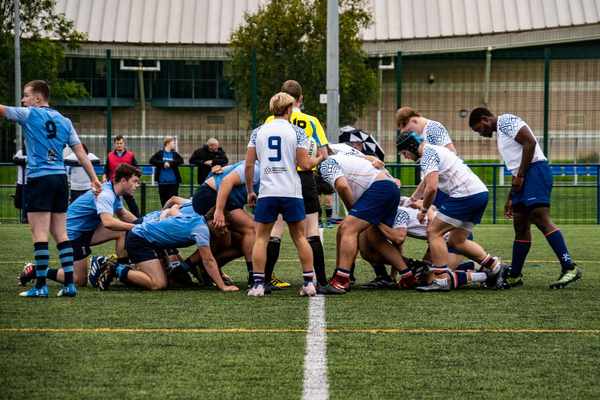
A lineout can look like a brief pause in rugby union: forwards assemble beside the touchline, a hooker throws, and someone rises above the crowd. In reality, it is a contest shaped by positioning, timing and detailed laws. Winning clean ball can launch an attack; mistiming a lift or drifting offside can give possession away. These rugby lineout rules explain what to watch and why referees make their decisions.
When is a lineout awarded?
A lineout restarts play after the ball or a ball-carrier goes into touch, across the touchline. Usually, the team that did not put the ball into touch throws in. There are exceptions: a team kicking a penalty into touch normally retains the throw, while a valid 50:22 kick can also earn the kicking team the lineout.
The referee or assistant referee identifies the mark of touch, where the lineout forms. It cannot be formed within five metres of either try line. Our guide to rugby kicking rules explains more about territory and possession.
Where do the players stand?
Each side forms one line between the five-metre and 15-metre lines, half a metre from the mark of touch on its own side. That leaves a one-metre gap separating the lines before the throw. At least two players from each team are required.
The throwing team chooses the maximum number of players in the lineout. The defending side may use fewer, but generally cannot use more once it has formed. Under the current global law trial, teams have 30 seconds from the mark being made to form the lineout; failing to do so brings a free-kick.
What about the thrower and receiver?
The thrower stands at the mark with both feet on or behind the touchline and cannot step onto the field before releasing the ball. The non-throwing team stations an immediate opponent near the five-metre channel. Each team may use one receiver, commonly a scrum-half, positioned two metres back from its lineout players between the five-metre and 15-metre lines.
How does the lineout throw work?
For a conventional lineout, the ball must travel straight along the mark of touch towards a lineout player. It must reach the five-metre line before hitting the ground, and the thrower cannot delay or fake the throw. Accuracy matters: a misplaced throw can surrender a valuable attacking opportunity.
There is a significant qualification to the straight-throw rule. Under World Rugby’s global law trial, if the throw is not straight but the opposing team does not lift a teammate to contest it, play continues. If the opposition lifts someone to compete, it receives the choice of a lineout or scrum. The change avoids unnecessary stoppages; deliberately crooked throws are not permitted.
Short throws to the front and long throws beyond the lineout still need to be straight. The principle is fair competition, not freedom to throw anywhere.
Lineout lifting: what is allowed?
Lineout lifting helps a jumper reach the ball, but strict safety requirements apply. Teammates may pre-grip a jumper in permitted positions. They cannot lift, support or jump before the ball leaves the thrower’s hands. Supporters must lower an airborne teammate safely as soon as either side wins possession.
Opponents cannot make contact before the throw or tackle a jumper in the air. Players may compete for possession without pulling, pushing or destabilising someone aloft. That explains why a referee may penalise dangerous interference even when a defender seems to be reaching for the ball.
A practical example of lineout tactics
Imagine an attacking team five metres from the opposition’s try line. It lines up six forwards but disguises its intended jumper. On the hooker’s call, two lifters raise a middle jumper, who secures the throw and transfers it back. Teammates form a driving maul and try to advance.
Timing is crucial. Lift too early and the side risks a free-kick; obstruct an opponent or illegally collapse the drive and a penalty may follow. See rugby maul rules for what can happen after the catch.
Can a team take a quick throw instead?
Yes. A quick throw restarts play before a conventional lineout forms. It uses the original ball, which must not have been touched after going out by anyone except the thrower or the player who carried it into touch. Both feet of the thrower must be outside the field.
Unlike a conventional lineout throw, a quick throw may travel parallel to the try lines or towards the thrower’s own try line. It is taken between the mark of touch and that team’s try line. The ball must reach at least five metres into the field before it touches the ground or anyone plays it. Once a lineout forms, a quick throw is no longer available.
Common infringements and referee decisions
Not all offences carry the same sanction. A free-kick can follow early lifting, a gap or numbers infringement, delaying the throw, or failing to lower a jumper safely. An incorrect throw or throwing-position offence can instead give opponents a choice between another lineout and a scrum. Contact before the throw or tackling someone in the air can bring a penalty.
Players outside the lineout normally stand at least ten metres back on their side of the mark, or behind their try line if closer. Detailed offside provisions allow certain movement after the throw, particularly when it travels beyond 15 metres. The principle remains: do not gain an unlawful head start. The guide to rugby offside rules covers the broader game.
When does the lineout end?
Catching the ball does not automatically end a lineout. It ends when the ball or ball-carrier leaves the lineout, enters the channel inside five metres, or goes beyond 15 metres. It can also end when a ruck or maul moves fully beyond the mark of touch, or the ball becomes unplayable. Until then, restrictions on players remain relevant.
Frequently asked questions
How many players are required for a rugby lineout?
At least two from each team. The throwing team sets the maximum number, while the defending side may generally match it or use fewer.
Does every crooked lineout throw mean a scrum?
No. Under the global law trial, play continues if the defence does not lift a teammate to contest a not-straight throw. If it does lift to compete, it receives a lineout-or-scrum option.
Can players lift a jumper before the throw?
They may take a legal pre-grip, but the lift, support or jump cannot begin until the ball leaves the thrower’s hands. The jumper must be brought down safely.
Is a quick throw the same as a normal lineout?
No. A quick throw occurs before the lineout forms, uses the original ball and has different direction rules. A conventional lineout is a structured contest with two lines of players.
Conclusion
Understanding how rugby lineouts work starts with correct formation, a fair throw and safe competition in the air. Add quick throws, offside lines and the current uncontested-throw trial, and this set piece becomes easier to follow. Watch the spacing and timing at the next restart; they often explain the referee’s decision.